
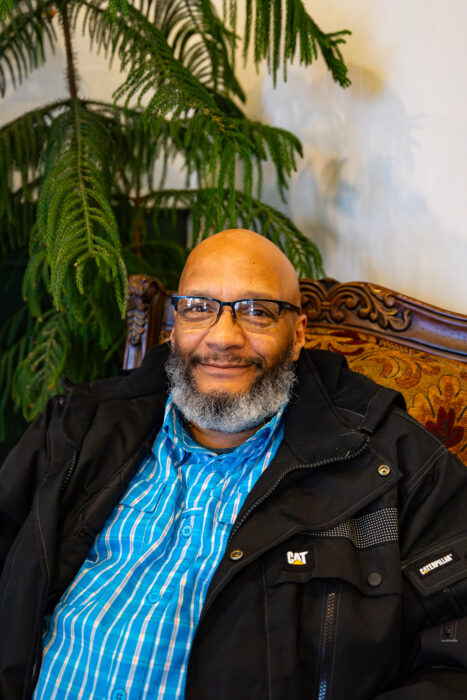
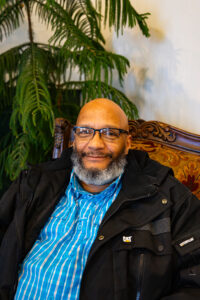
 Indulging in his own homemade German chocolate cake is a guilty pleasure that James Lloyd Johnson Jr. says is one of his “better bad decisions” since becoming sober in 2024. “Thanks to my grandmother, I like to cook. It helps me to connect and bring joy to other people,” James says.
Being present and making connections did not come easy for James for most of his life. The 61-year-old Wilkes-Barre resident says learning to trust and be vulnerable, even when it hurts, has been essential to his recovery while working with the substance use disorders team at Robinson Counseling Center.
Having recently celebrated his second anniversary of sobriety, James says that treatment and support have helped him to redirect his energy – opening him to the faith, family, and friends that he ran from on and off for 35 years.
“I had built walls, disliked people and trusted no one. Now, I am tearing that down. Robinson Counseling Center has given me the courage to share the truth, and by the grace of God, I am healing. I want my mess to become my message,” he says.
“You know, being sober is an abnormal state for me. Drinking and drugs were a way to abandon my shame and run from the consequences of my actions. But, if you don’t deal with life, life will deal with you,” James says.
After James connected with Drug and Alcohol Counselor Rebecca Zebley, he soon realized that sobriety could not be sustained without good mental health. Individual and group therapy slowly helped him to release anger. “I started to have some clarity about where I came from and its impact on my choices,” says James.
Rebecca says James’ recovery journey is a true testament to what recovery looks like. “It is not just about stopping the use of a substance; it is about creating a life that you do not feel the need to escape from. The substances are not the source of your struggles; they became the solution that you thought would help you to survive the inner turmoil that was already there,” she explains.
According to Zebley, the Substance Use Disorders Program at Robinson Counseling Center “strives to help individuals find new solutions to help them lead healthy, more fulfilling lives. The goal is twofold: recovery from addiction, and healing from anything else that is too heavy to manage on your own. We work to help clients manage their lives rather than avoiding challenges with the use of substances,” Zebley says.
James first tasted alcohol as a five-year-old – offered by his father while entertaining friends who were keen on Ripple, a low-cost, fruity wine that was popular in the 1970s. “I started to drink it regularly despite being an only child with two parents who could watch my every move. As I looked back, I wondered how they could have allowed that in my young life. My father also encouraged me to smoke marijuana while in elementary school,” James says.
Before his teen years, James was the “engine” in his play group, pulling other kids around in a wagon. “I remember going inside to fuel up because I was thirsty, but I was not drinking water. It was already a problem.”
James and his parents moved several times when his father served in the Marine Corps, making friendships short and childhood lonely. “My mother, Betty, was a force of nature – taking care of me and creating a loving home for us, but my father wasn’t the same man when he returned home from his second tour in Vietnam.”
While James was still in grade school, he and his mother faced increasing physical abuse by his father, which eventually forced them to leave and move closer to extended family. By the mid-1970s, the effects of such trauma were firmly rooted in the young teen who already had an alcohol habit.
Using substances eventually expanded into dealing drugs, says James, who spent 12 years in and out of detention centers “wasting a lot of years and closing down any opportunity to improve my life and relationships,” which included two children of his own. “I made a lot of wrong choices. I was a parent, but I was not a dad; emotionally, I was all about the addiction.”
In 1991, he landed in northeastern Pennsylvania – still using and dealing, while erratically reaching out for help. During the years as a “fence rider” between jail and incarceration, James found some clarity and support from Canon Don Muller, who was Rector at St. Stephen’s Episcopal Church, Wilkes-Barre, from 1996-2004. “I would stop and ask, ‘You got some time to talk?’ He always did, and I would pour out my soul. He never judged. I thought it was strange that I could connect with a man, because I had so many father issues.”
Being in and out of treatment for more than 30 years, James got tired of starting over. “I ran from anyone who tried to help. I was going to do it my way, but my way got me nowhere,” he says.
In spring of 2024, James started intensive outpatient treatment at Robinson Counseling Center. After a relapse, he re-entered the program – and committed to clearing a path that has led to trusting others and believing in himself. And it starts every morning with one goal – 24 hours of sobriety – to build a better life and maintain his well-being.
According to James, sobriety is the only reason he was able to be there for his mother in November 2025, when a heart condition landed her in the hospital one last time. “She called me to say she was hospitalized again, and I knew I had to be with her that day. I had no way to get there, but I called my cousin, and she did not hesitate. Several hours later, James was at his mother’s bedside in suburban Philadelphia, holding her hand.
“I had a few tender hours to show her my love and thank her for all she did for me. It meant everything to tell her that I was sober and making better progress than I ever had before. If that day had happened in the past, I would not have been present when precious moments counted. I am grateful that she left this earth knowing I loved her and that I was moving in a better direction,” James says.
While the grief was only a few days old, James and his extended family stayed with the plan to host Thanksgiving at his mother’s house. “We were hurting, but we were all together just as my mother would have wanted – with a lot of tears and laughter around the table.”
“That is how it is with my treatment team, too, and my friends – everyone who is involved in my recovery. I do not have to do it myself, in fact I cannot do it by myself,” says James.
“My biggest shame with addiction was making myself a stranger to my family. But I am eager to keep showing up for myself and for them.”
These days, James wants to make new family memories like those with his grandmother, who patiently taught him to cook when he was young. “I ruined a lot of food in her kitchen, but she could salvage anything. No measuring, just poured it all together and it was perfection.”
“Not me, I like to follow a recipe and this time around, I want to get it just right.”
Substance Use Disorders
A Team Focused on Connection for Recovery
The Substance Use Disorders (SUD) Program at Robinson Counseling Center opened in 2018 and has since supported 10,000 individuals to begin and manage their recovery from drug and alcohol challenges. The program includes intensive outpatient treatment, individual and group therapy, and Medication Assisted Treatment (MAT) delivered by a multidisciplinary team that includes certified drug and alcohol counselors, mental health therapists, psychiatrists, certified registered nurse practitioners, and certified (peer) recovery specialists.
While conducting prevention education at dozens of schools and community events, the SUD team also operates a Community Warm Handoff Program, which assists several hundred people annually who are experiencing substance-induced medical emergencies. This timely response provides support and understanding to ease the uncertainty of accessing treatment due to a variety of barriers.
If you or a family member need help getting started, call 570-301-0935 and press 2.
Leave a Reply